Table of Contents
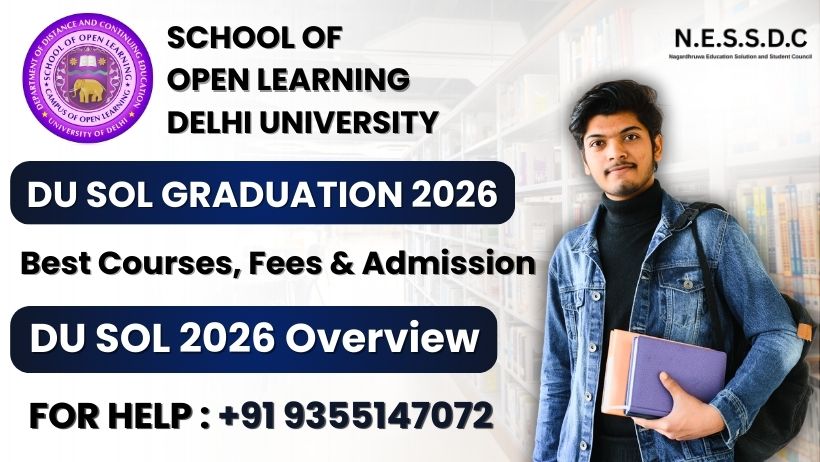
Obtaining a degree from a prestigious institution like Delhi University is a dream for millions. The **School of Open Learning (SOL)**, established by the University of Delhi, makes this dream accessible to everyone. **DU SOL Graduation 2026** offers a perfect blend of academic rigor and flexible learning, allowing students to earn a valuable degree without the constraints of regular college attendance.
1. What is DU SOL?
The **School of Open Learning (SOL)** was established in 1962 as a pioneer institution in the field of distance education in India. It is a constituent college of the University of Delhi (DU). SOL allows students to pursue undergraduate (UG) and postgraduate (PG) courses primarily through distance mode.
The curriculum, syllabus, and examination patterns of SOL are identical to the regular colleges of Delhi University. The degree awarded to SOL students is also indistinguishable from the one awarded to regular DU students, ensuring equal value in the job market and higher education circles.
2. Why Choose DU SOL Graduation?
Enrolling in DU SOL comes with significant advantages, catering to a diverse range of students:
- Prestige: You get a degree from the **University of Delhi**, one of India's most respected educational institutions.
- Flexibility: There are no mandatory attendance requirements. This is ideal for students preparing for competitive exams (UPSC, CA, CS) or working professionals.
- Affordability: The fee structure is extremely economical compared to private universities or even regular colleges.
- Equality: The study material is prepared by experienced DU faculty, and the degree holds the same weight as a regular degree for government jobs and further studies (M.A., M.B.A., etc.).
- Online Support: With recent upgrades, SOL offers online classes, digitized study material, and a seamless online dashboard for students.
3. Courses Offered (UG & PG)
DU SOL offers a variety of courses in Arts and Commerce streams. For the 2026 academic session, admissions are mainly open for the following undergraduate programs:
Undergraduate (UG) Courses
- B.A. (Programme): A comprehensive course covering subjects like History, Political Science, Economics, and Education.
- B.A. (Hons) Political Science: Focused study on political theory, Indian government, and international relations.
- B.A. (Hons) English: Study of classical and modern literature, poetry, and drama.
- B.Com (Programme): Covers fundamentals of accounting, business law, and economics.
- B.Com (Hons): An advanced course in commerce specializing in accounting, taxation, and corporate laws.
- BA (Hons) Economics: A rigorous program for students interested in economic theory and applications.
- BBA (FIA) & BMS: SOL has also introduced management courses like Bachelor of Business Administration (Financial Investment Analysis) and Bachelor of Management Studies.
Note: SOL also offers Postgraduate (PG) courses like M.A. in History, Hindi, Sanskrit, Political Science, and M.Com.
4. Eligibility Criteria 2026
The eligibility criteria for DU SOL are generally relaxed compared to regular colleges (where cut-offs skyrocket). However, candidates must meet specific requirements:
| Course | Minimum Eligibility (Class 12th) |
|---|---|
| B.A. (Programme) | Passed Class 12th from a recognized board (CBSE/NIOS/State Board). Minimum 33% marks. |
| B.Com (Programme) | Passed Class 12th. Minimum 33% marks. |
| B.A. (Hons) Eng/Pol Sci | Passed Class 12th with approx 50% marks (may vary slightly). Specific subject requirements apply. |
| B.Com (Hons) | Passed Class 12th with 55% marks or 60% in Vocational stream. Math is often preferred but check specific notification. |
5. Fee Structure
One of the biggest draws of DU SOL is its low cost. The fee is payable annually.
- Admission Fee (1st Year): Approximately ₹4,000 to ₹5,500 depending on the course and category. This includes examination fees.
- Subsequent Years: Approximately ₹3,500 to ₹4,000 per year.
- PwD Candidates: Exempted from tuition fees; they only need to pay nominal charges.
6. Admission Process
The entire admission process is **Online**. You do not need to visit the campus at North or South Campus for admission.
- Registration: Visit the official SOL website (sol.du.ac.in). Click on "New Registration" and create a login using your email and mobile number.
- Fill Form: Log in and fill out the detailed application form. Enter your academic details from Class 10 and 12 accurately.
- Upload Documents: Upload scanned copies of:
- Recent Photograph and Signature.
- Class 10th and 12th Marksheets.
- Migration Certificate (if from a board other than CBSE/NIOS Delhi).
- Caste Certificate (if applicable).
- Subject Selection: Choose your Core papers and Elective subjects carefully.
- Fee Payment: Pay the fees online via Debit/Credit Card or Net Banking.
- Download ID Card: Once the payment is verified, you can immediately download your **Fee Receipt** and **SOL Identity Card**. Admission is confirmed instantly in most cases.
7. Frequently Asked Questions (FAQ)
Q: Is the DU SOL degree valid for government jobs?
Yes, absolutely. The degree is awarded by the University of Delhi. It does not mention "School of Open Learning" on the main degree certificate (only on the marksheet in some cases) and is fully valid for UPSC, SSC, Bank PO, and other government exams.
Q: Does SOL have a placement cell?
Yes, SOL has an active **Placement Cell** that organizes job fairs and drives. Companies like Dalmia Group, HDFC Bank, and various BPOs have recruited from SOL in the past.
Q: Can I migrate from SOL to a Regular College?
It is possible but difficult. Migration is allowed in the 2nd year only if you have high marks in the 1st year and the receiving regular college has a vacant seat and consents to the migration.
Q: When do DU SOL admissions for 2026 start?
Admissions typically start in **June or July**, shortly after the CBSE Class 12th results are declared. The window usually remains open until late August or September.